How to Choose the Right Carbon Tube for Your Needs?
Choosing the right Carbon Tube requires more than comparing diameter, weight, and price. A tube may look rigid on a workbench, yet fail under vibration, crushing, or repeated bending. Carbon fiber’s performance depends on fiber direction, resin system, wall thickness, and manufacturing quality. Small details matter.
Industry data supports this careful approach. MarketsandMarkets’ Carbon Fiber Market report identifies aerospace, wind energy, automotive, and sporting goods as major demand sectors. Grand View Research also reports continuing growth in carbon-fiber-reinforced polymer applications, driven by lightweight design and corrosion resistance. These trends explain the wider selection now available. They do not identify the correct tube for your project.
Start with the actual load. Will the tube carry tension, compression, torsion, or impact? Record the required length, outer diameter, inner diameter, and support spacing. Then check the manufacturer’s fiber orientation and tolerance data. A unidirectional tube can provide excellent axial stiffness. A braided tube may handle twisting more effectively. Not every specification sheet is equally complete.
Look for test evidence, not attractive claims. ASTM methods, such as ASTM D3039 for tensile properties, can support material comparisons. However, a test coupon does not perfectly represent a finished tube. Joint design, drilling, temperature, and moisture can change performance. That limitation deserves attention.
A sensible choice balances stiffness, strength, safety margin, and budget. It should also match the cutting and joining methods available in your workshop. I would not select the lightest option automatically. Sometimes, a slightly heavier Carbon Tube offers better durability and fewer installation problems. That is where careful engineering judgment matters.
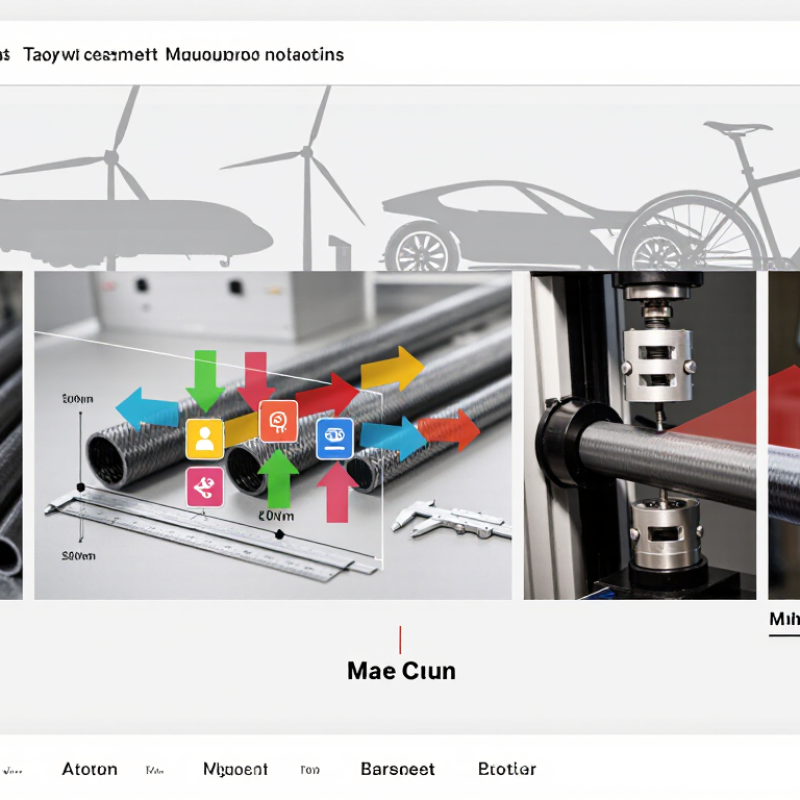
Define Your Carbon Tube Application and Performance Requirements
Defining the carbon tube application is the first engineering decision. A tube for a camera boom faces different demands than one for a robotic arm. Record the primary load, bending direction, impact risk, operating temperature, and exposure to moisture or chemicals. Also define the required length, diameter, wall thickness, tolerance, and attachment method. Small details matter.
The Carbon Fiber Market Size, Share and Trends Analysis Report, 2024–2030, estimates the global carbon fiber market will expand at about 8% annually through 2030. This growth reflects wider use in transport, energy, sporting equipment, and industrial structures. However, market growth does not make every carbon tube suitable. A unidirectional tube can provide strong axial performance, while a braided or cross-ply structure usually handles torsion and multi-directional loading better. Choosing by appearance alone is risky.
Test the real assembly, not only the tube. Measure deflection under working load, inspect the joints, and repeat the test after temperature or moisture exposure. A safety factor should reflect uncertainty, impact, fatigue, and manufacturing variation. ISO 14125 provides a recognized framework for testing fiber-reinforced plastic flexural properties, although tube-specific fixtures may still require careful adaptation. This part is often underestimated.
A lighter tube may reduce system weight but feel too flexible during operation. That trade-off deserves review. The Global Wind Report 2024 from the Global Wind Energy Council recorded 117 GW of new wind capacity installed in 2023, showing the scale of demanding composite applications. Yet even good data cannot replace application-specific validation. A neat specification can still miss one awkward load at the joint.
Compare Carbon Tube Types, Materials, and Structural Designs
Choosing a carbon tube begins with the load, not the catalog label. A tube for a camera boom may need low mass and bending stiffness. A tube for a drive shaft also needs torsional strength and fatigue resistance. Pultruded tubes usually provide strong axial performance at predictable cost. Roll-wrapped tubes offer controlled fiber angles and smooth dimensional accuracy. Filament-wound designs can distribute fibers around complex loading paths. Each type has trade-offs. None is universally best.
Most tubes use carbon fibers in epoxy resin. Fiber grade affects stiffness and strength, while resin controls heat resistance, toughness, and moisture behavior. Thermoplastic matrices can improve impact tolerance and repairability, but processing may be more demanding. Hybrid glass-carbon construction can reduce cost and soften sudden failure. Check wall thickness, inner diameter, fiber orientation, and joint design together. A thin, stiff wall can buckle near a clamp. That detail gets missed.
For structural design, unidirectional layers suit axial loads. ±45-degree layers support torsion. Woven layers improve handling and damage tolerance. Sandwich or ribbed interiors may raise stiffness without adding much mass, though inspection becomes harder. Measure service temperature, vibration, and chemical exposure. Then request test data for compression, bending, fatigue, and impact. I would not rely on tensile data alone. A practical trial includes a short prototype, real clamps, and repeated loading. Early calculations can be wrong. Revise them after testing. Use qualified engineers for safety-critical assemblies and verify applicable standards before production.
How to Choose the Right Carbon Tube for Your Needs?
Comparing carbon tube types, materials, and structural designs
How to read this chart: Specific tensile strength is calculated from representative tensile strength divided by material density. A higher value generally indicates better strength efficiency by weight. The figures are typical engineering values and may vary with fiber orientation, resin content, manufacturing quality, and tube geometry.
Selection guidance: Unidirectional carbon tubes are suitable for high axial stiffness and tensile loads. Woven carbon tubes provide more balanced strength in multiple directions and improved impact tolerance. Braided or filament-wound designs are useful when torsional loads, complex shapes, or impact resistance are important. For maximum performance, match the lay-up direction and wall thickness to the main load path.
Select the Proper Tube Dimensions, Strength, and Weight
Choosing a carbon tube starts with dimensions, not appearance. Measure the outer diameter, inner diameter, wall thickness, and unsupported length. A larger diameter often improves bending stiffness without adding much material. However, thin walls can dent, split, or buckle near clamps. CMH-17-3G data commonly places carbon/epoxy laminate density near 1.5–1.6 g/cm³, compared with about 2.7 g/cm³ for aluminum. Longitudinal tensile strength may range from roughly 700 to 1,500 MPa, depending on fiber direction, resin, and manufacturing quality.
Strength is not a single number. A tube carrying axial tension needs different reinforcement from one resisting bending or torsion. For bending, place more carbon along the tube axis. For torsion, angled plies are important. Under Euler buckling theory, doubling an unsupported tube’s length can reduce its critical buckling load to one-quarter, assuming other conditions remain unchanged. That detail is easy to overlook. Check joint loads too. A strong tube can still fail around a poorly designed bolt hole or clamp.
Weight targets require restraint. Removing wall thickness may save grams but reduce impact tolerance sharply. ASTM testing practices can compare tensile and compression results, yet laboratory values do not fully represent field damage. I would specify a safety factor, inspect the surface under bright light, and request test data for the actual layup. The lightest tube is not always the most reliable choice. Sometimes, it is simply underbuilt.
Evaluate Surface Finish, Tolerances, and Environmental Resistance
Choosing a carbon tube starts with its surface finish, not its color or shine. Surface quality affects bonding, sliding contact, and visual inspection. A smooth outer wall helps when the tube fits into a molded socket. A lightly textured surface may hold adhesive better. However, excessive roughness can hide cracks, voids, or uneven resin. I once rejected a tube that looked perfect under bright light but felt irregular along its length. The tactile check revealed more than the photograph.
Tolerances deserve equal attention. Measure the outside diameter, inside diameter, wall thickness, and straightness. A basic caliper is useful, but it may miss small variations inside a long tube. Request inspection data and confirm how measurements were taken. Temperature can also change results slightly. For precision assemblies, test several points rather than one end. A single measurement is not enough. Do not assume a stated tolerance matches your actual application; verify the fit with a sample whenever possible.
Environmental resistance depends on the tube’s resin system, coating, and intended exposure. Moisture can affect bonding, while ultraviolet light may weaken unprotected surfaces over time. Heat, salt spray, fuels, and cleaning chemicals require separate checks. Ask for documented test conditions, not vague claims of durability. Short exposure tests are helpful, but they cannot predict every field failure. I have learned that laboratory confidence can still be incomplete. Leave a safety margin, especially when temperature and vibration occur together.
Verify Quality Standards, Manufacturing Options, and Total Cost
Selecting a carbon tube starts with its quality evidence, not its glossy surface. Ask for batch records, fiber orientation, resin system, and test results. ISO 9001 certification supports process control, but it does not prove every tube meets your load requirements. Request tensile, compression, flexural, and dimensional data tested under relevant ASTM or ISO methods. The 2024 carbon fiber market analysis from Fortune Business Insights estimates the market reached about 4.5 billion dollars in 2024. That growth increases supply, but consistency still varies between manufacturers.
Manufacturing options change performance and price. Pultruded tubes offer stable dimensions and efficient production for straight, repeated profiles. Roll-wrapped tubes allow tailored angles, wall thicknesses, and local reinforcement. For a shaft exposed to twisting, a mostly longitudinal layup may be a poor choice. Add off-axis plies when torsional strength matters. Custom tooling can improve fit, yet it may add weeks and setup charges. Small batches often reveal this hidden cost.
Compare total cost, not the purchase price. Include tooling, inspection, machining, shipping, protective packaging, and rejected parts. A lower-cost tube can become expensive after extra drilling or alignment work. Industry market reports also disagree on growth rates, which is a useful warning: forecasts depend on definitions and data sources. I would verify supplier claims with a sample inspection and a simple load test. Perfect paperwork is not enough. Real use exposes weaknesses.






